
When I Consider How My Light Is Spent
When I consider how my light is spent,
E’re half my days, in this dark world and wide,
And that one Talent which is death to hide,
Lodg’d with me useless, though my Soul more bent
To serve therewith my Maker, and present
My true account, least he returning chide;
“Doth God exact day-labour, light denied?”
I fondly ask; But patience to prevent
That murmur, soon replies, “God doth not need
Either man’s work or his own gifts; who best
Bear his milde yoak, they serve him best. His State
Is Kingly. Thousands at his bidding speed
And post o’re Land and Ocean without rest:
They also serve who only stand and wait.
Poem written by John Milton (1673).
Commentary
When I consider how my light is spent is a sonnet written by John Milton that is sometimes given the title On his blindness. The poem has features of a classic sonnet – it has 14 lines and it builds up an argument that changes halfway through the poem after a break (when he questions “Doth God exact day-labour, light denied?”). In the first half, he is slightly bitter about God depriving him of his sight and the worthless feeling he experiences when he is not able to serve his ‘Maker’ as he wishes to. Towards the end of the sonnet, he becomes more patient, learns to see ‘things in a different light’ and accepts his blindness. “They also serve who only stand and wait”.
John Milton (1608-1674) was an English poet, still regarded as one of the greatest English writers. He wrote poems by dictating to his amanuenses* after he lost his sight (the cause of which remains unknown, but plausibly untreated glaucoma or bilateral retinal detachment). He was born at a time when several movements and wars were brewing. He must have seen life through a unique pair of lens and legend has it that he got a chance to meet Galileo Galilei. At St Paul’s School he must have been well aware of John Donne, the eminent metaphysical poet whose sermons attracted huge crowds as Dean of St Paul’s Cathedral from 1621 – 1631.
*amanuenses – a literary or artistic assistant, in particular one who takes dictation or copies manuscripts.
More info
- When I consider how my light is spent – The poem, with minor grammatical errors and misspellings; (Gutenberg project)
- John Milton – Biography from Britannica; Some info for commentary was written with the help of this Wiki link
- More literature from John Milton
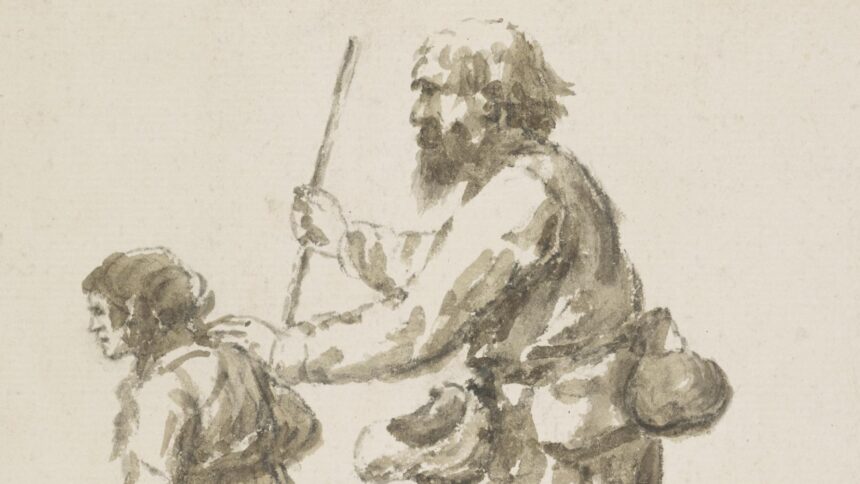
- Featured image – Francesco Zuccarelli, A Blind Man Led By a Girl. Scottish National Gallery, RSA (David Laing bequest)(detail)
- (Previous featured image – John Milton Dictates the Lost Paradise to his three daughters, ca. 1826, by Eugène Delacroix, Current location – Williamstown (Massachusetts)/Sammlung G.H. Hamilton, Wikimedia commons.)
Contributed by
Lekaashree Rambabu